Ecology · Predator competition
Diets, dominance hierarchies, and kleptoparasitism drive asymmetrical interactions between wolves and cougars
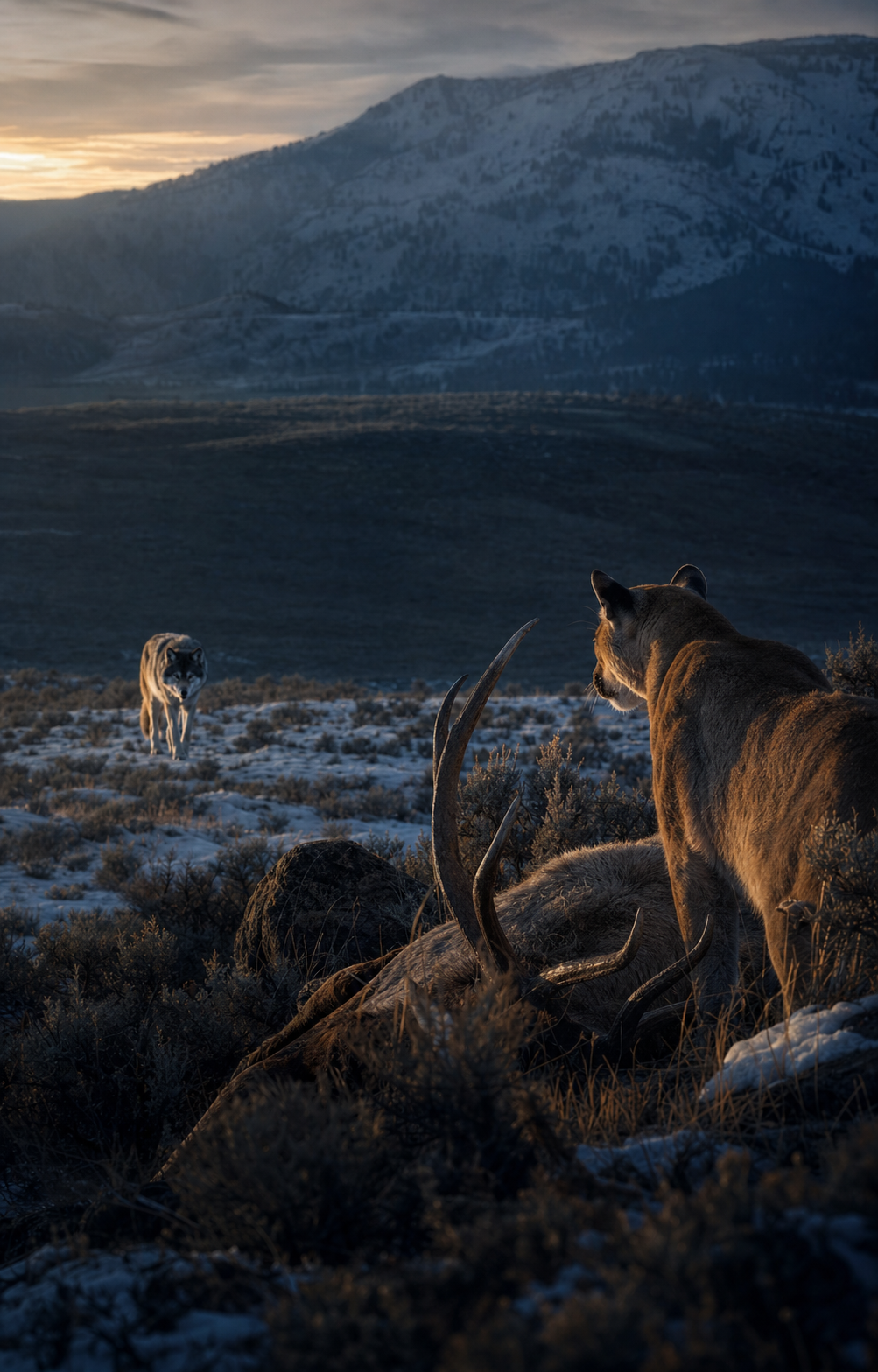
Nine years of GPS telemetry expose a lopsided Yellowstone rivalry: wolves seek out cougar kills; cougars avoid wolf kills and retreat toward rougher ground.
What changed.
Why it matters.
By joining carcass investigations with movement models, the researchers locate competition at cougar kills—often while the cougar is still nearby.
Coexistence becomes a measurable system of food theft, terrain, prey size and mortality rather than a vague story about two predators sharing a landscape.
It does not show that elk decline caused coexistence or that Yellowstone’s pattern holds elsewhere.
Signal and judgment,
kept separate.
A rare paired, multi-year telemetry record and openly reported data and code make the mechanism unusually inspectable.
The ascendance gate is closed insufficient history. This dossier is not presented as proof of global momentum.
1 observation point across 0 days.
Observed 2026-07-22. The current assessment used 1.
Compared with 9 papers of similar age, type and discipline.
A signal of attention, never a quality score or truth score.
Cadence: 14 days.
Not calculated yet: citation velocity, acceleration and a momentum score require more history. Missing values are not treated as zero.
The finding.
Without the hype.
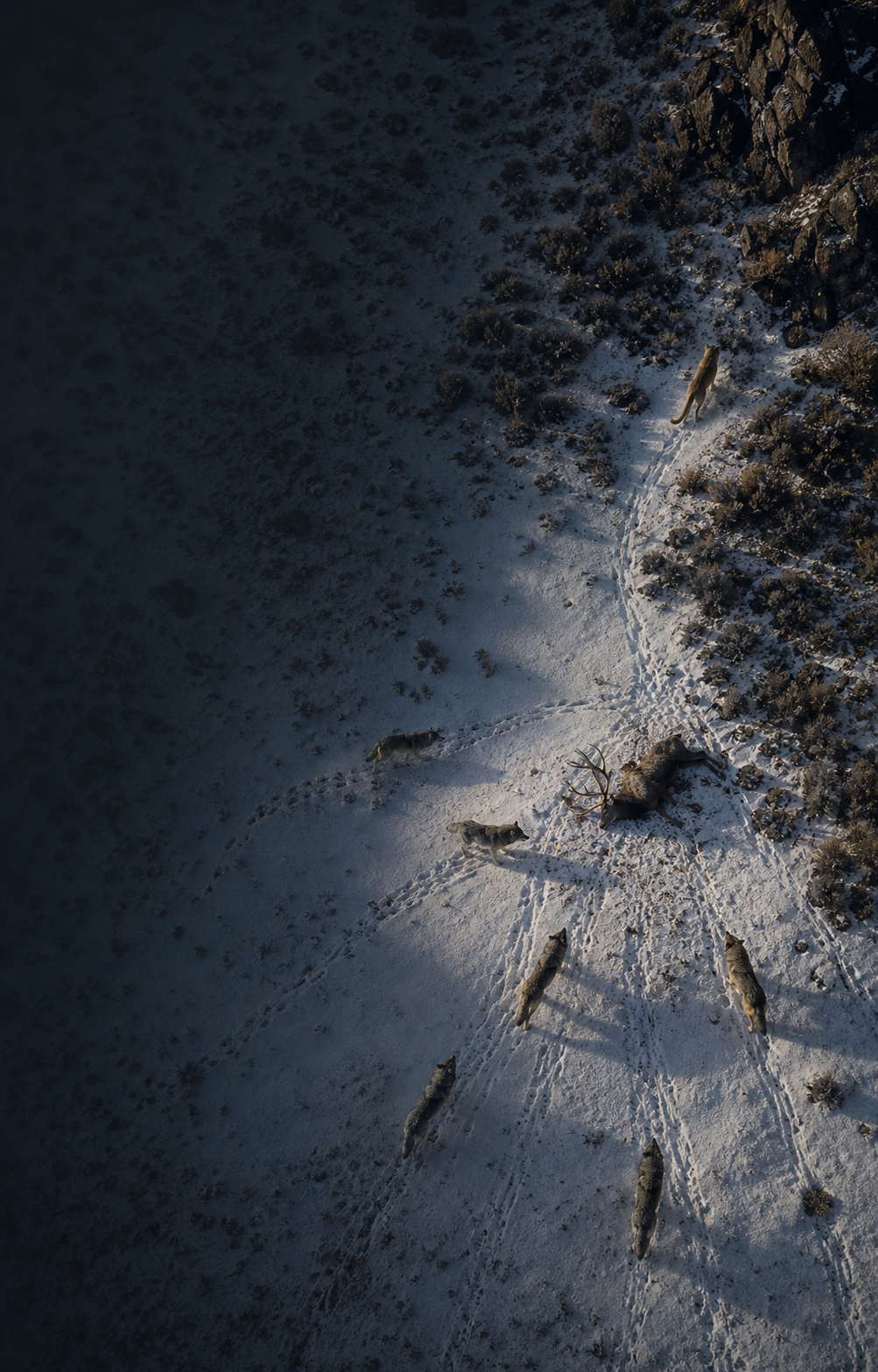
Nine years of telemetry and field monitoring in Yellowstone reveal a strongly asymmetric interaction. Wolves selected cougar kills, especially while a cougar was still present; 33 of 79 detected encounters coincided with predicted cougar kills, and wolves were linked to two of 12 adult cougar deaths. Cougars avoided wolf kills and selected rougher terrain near wolves. Prey size is a plausible part of the mechanism, but direct elk-versus-deer comparisons were only marginal.
Wolves were linked to two monitored adult cougar deaths.
That is 16.7% of known adult-cougar deaths in 2016–2024; the sample is small and comes from one ecosystem.
Wolves showed stronger selection for a cougar kill while the cougar was still present.
The estimate differed from zero (P < 0.001), but it is an observational model result, not an experimental effect size.
Nearly 42% of detected encounters occurred at predicted cougar kills.
Only one occurred at a wolf kill; kill sites were partly model-predicted rather than directly observed.
The kill-site models discriminated field-verified clusters reasonably well.
Range across wolves and cougars in winter and summer; model performance does not remove errors from predicted kill locations.
It does not show that elk decline caused coexistence or that Yellowstone’s pattern holds elsewhere.
Go deeper
only when you want to.
72 evidence links ground this dossier. Source quotations and full text are checked locally but are not redistributed.
01Study design and methods 7 mapped items
Longitudinal observational ecology using GPS telemetry, predation monitoring and integrated step-selection modelling
Random-forest models were trained on field-verified GPS clusters to predict kill versus non-kill sites by season and provide likely sites for movement models.
This was a longitudinal observational study of an ecological system, with no experimental assignment of exposure, combining telemetry and predation observations.
Deaths were investigated in the field. Feeding events were identified from GPS clusters, prey remains and observations, while causes of death used necropsy and field evidence.
An encounter required simultaneous proximity: within 250 metres of the competitor and 100 metres of its kill. Meeting both thresholds was treated as evidence consistent with scavenging or kleptoparasitism.
The analytical population comprised wild wolves and cougars fitted with GPS collars in northern Yellowstone and adjacent lands.
Data were restricted to winter and spring–summer months with predation monitoring; movement analyses required contemporary hourly GPS fixes.
The team used integrated step-selection functions with 20 random steps per observed step, binomial GLMs, AIC model comparison and relative selection strength to interpret parameters.
02Claim map 6 claims
Detected encounters were strongly asymmetric: 33 of 79 coincided with predicted cougar kills, while only one occurred at a wolf kill.
Classification depends on spatial thresholds and predicted kill sites, not direct observation of every encounter.
Wolf movement showed selection toward cougar kills, and selection increased when the cougar was still present—consistent with kleptoparasitism.
This is an association estimated with integrated step-selection models and partly predicted kill sites, not an experiment.
Cougars avoided wolf kills and selected rougher terrain as their distance to wolves decreased.
There was no general distance-based avoidance of wolves, and the wolf-kill effect was not detected in summer.
Between 1998–2005 and 2016–2024, both predators used less elk and more deer, reducing dietary overlap.
The period comparison describes concurrent change; it does not identify elk decline as the sole cause.
Wolves were linked to two of 12 adult cougar deaths, while cougars were linked to none of 90 wolf deaths.
Cougar counts are small and describe monitored animals with known fates in one ecosystem.
Probable kleptoparasitism was more frequent at elk kills than deer kills, consistent with larger prey extending the encounter window.
The direct elk-versus-deer tests were only marginally significant: P = 0.092 for discovery and P = 0.07 for probable kleptoparasitism.
03Limits and cautions 10 checks
Separate observational associations from causal claims about diet, coexistence and competition.
Errors in kill-site models can propagate into movement and interaction estimates.
Do not present prey size as a confirmed mechanism; the direct tests were marginal.
The paper does not include a dedicated limitations section; the clearest author-stated caution concerns the seasonal comparison.
The prey-size hypothesis has effects in the expected direction and of notable magnitude, but neither direct elk-versus-deer test crossed the conventional 0.05 threshold.
Many kill sites were predicted, and binary prediction did not distinguish ungulate species. Classification errors can feed into interaction models.
The work comes from a single Yellowstone system with distinctive topography, prey and reintroduction history; extrapolation requires external testing.
Fewer kleptoparasitic interactions in summer constrain the seasonal comparison.
The historical comparison coincides with lower elk density, but an observational before-and-after contrast cannot isolate elk decline from other temporal changes.
Encounters depend on 250/100-metre thresholds, and kills were considered available for 30 days. These operational assumptions require sensitivity analysis.
04Transparency 6 checks
Study code was deposited in the same Zenodo record.
The authors declared no competing interests.
Study data were deposited on Zenodo with a DOI.
The paper identifies support from NSF programmes, Yellowstone Forever and the National Park Service.
No separate policy for physical-material availability was reported.
No preregistration or registered analysis plan was reported.
Same science.
A different doorway.
This is the verified Spanish-language edition prepared by Hadox Social. It has not been published from this workflow.
Caption links to this canonical dossier.
Read the exact social caption
ARTÍCULO DE REVISTA Investigación de Wesley Binder y 6 coautores, publicada en Proceedings of the National Academy of Sciences. Hadox realizó la curaduría y divulgación; no realizó el estudio. Los autores observaron una asimetría extrema: 41.8% de los encuentros coincidieron con sitios predichos de caza de puma. El equipo siguió lobos y pumas con GPS entre 2016 y 2024 y combinó sus movimientos con monitoreo de depredación. Los movimientos observados indican que los lobos seleccionaron acercarse a presas de puma, especialmente si el puma seguía allí. Los resultados sugieren que los pumas evitaron los sitios de caza de lobo y eligieron terreno más rugoso cuando había lobos cerca. Límite: El artículo reporta un solo sistema de Yellowstone y muchos sitios de caza predichos sin distinguir la especie de ungulado; extrapolar exige pruebas externas. Fuente científica: Proceedings of the National Academy of Sciences — Diets, dominance hierarchies, and kleptoparasitism drive asymmetrical interactions between wolves and cougars https://doi.org/10.1073/pnas.2511397123 Expediente Hadox Science: https://hadox.org/science/papers/diets-dominance-hierarchies-and-kleptoparasitism-drive-asymmetrical-interactions-between-wolves-and-cougars-1f35582f #HadoxScience #Ciencia